
Fixing flaking exterior paint on a coastal Brighton property
Key takeaways
- Flaking exterior paint by the coast is almost always a damp and breathability problem, not just a worn-out finish.
- Salt air, driving rain and cheap non-breathable paint trap moisture in the wall, and the coating lifts off from behind.
- A fungicidal wash to kill algae and spores comes first, because painting over live growth just seals the problem in.
- Zinsser Peel Stop or a stabilising solution binds down the flaking, chalky edges so the new paint has something solid to hold to.
- On older solid walls the repaint has to be a breathable masonry paint, so the wall can release moisture instead of blistering again.
Why exterior paint flakes on a sea-facing wall
On a coastal Brighton property, exterior masonry or render paint usually flakes because moisture is trapped in the wall. Salt air, driving rain and a cheap non-breathable coating stop the wall drying out, so the paint lifts off from behind rather than simply wearing away on the surface.
A sea-facing wall in Brighton and Hove takes a beating that an inland wall never sees. The prevailing wind drives rain straight into the render, and the salt in that air holds damp in the surface long after the rain has stopped. On the exposed elevations, usually the south and west faces, that is where the paint goes first.
The thing most people get wrong is assuming the paint has just worn out. Nine times out of ten the finish has failed because moisture is trapped behind it. If the last coat was a cheap, plasticky, non-breathable masonry paint, it seals the wall like a skin. The wall still takes on water through hairline cracks and around the cill lines, but it cannot dry back out through the paint. The trapped moisture pushes the coating off from behind, and you get blistering, flaking and that chalky, powdery surface underneath.
On older solid-wall and lime-render properties, which there are a lot of around here, this matters even more. Those walls were built to breathe. Seal them with the wrong paint and you do not just lose the finish, you can start driving damp inwards.
- Flaking and blistering concentrated on the sea-facing, wind-driven elevations
- A chalky, powdery surface when you rub the old paint with your hand
- Green or black algae growth in the damp, shaded sections
- Hairline cracks in the render letting water in behind the coating
By the coast the paint is the last ten per cent of the job. If the wall cannot breathe and the surface is not stabilised first, the smartest colour in the world will be flaking off again within a couple of winters.
Diagnosing it and washing the wall down first
Before any paint, the wall gets diagnosed and cleaned. I check where the moisture is getting in, then wash the whole surface down with a fungicidal wash to kill any algae, mould and spores. Painting over live growth just seals it in and it comes back through the new coat.
I start by working out where the water is actually coming from, because a repaint on its own will not fix a wall that is being fed damp. That means checking the cracks, the cills, the pointing and any gutters or downpipes running over the elevation. If something is channelling water onto the wall, that gets sorted before I think about paint.
Then the wall gets washed down. On a coastal property there is nearly always algae or mould in the shaded, damp areas, and you cannot paint over it. I treat the whole surface with a fungicidal wash, which kills the spores rather than just wiping the green off the top. If you skip this and paint straight over it, the growth carries on living under the new coat and pushes back through within a season.
Once it is treated and rinsed, the wall has to dry out properly. In a seaside town that means watching the weather and picking a genuinely dry run, not just a dry morning. Painting onto a wall that is still holding damp is the fastest way to end up back where you started.
Stabilising, filling and the products I actually use
With the wall clean and dry, I deal with the loose, flaking and chalky surface. I scrape and brush off everything that is not properly stuck, then bind down what is left. A chalky old render will not hold paint on its own, so this step is what stops the new coat lifting straight back off.
For stabilising I use Zinsser Peel Stop, a binding primer that soaks into flaking, chalky or unstable edges and locks them down, tying the sound surface and the feathered edges together so the topcoat has something solid to grip. On a really powdery, dusty old render a stabilising solution does a similar job, sealing the chalky surface so it stops shedding. Either way, the point is the same: give the new paint a stable base instead of painting onto dust.
The cracks get filled next. I use an exterior-grade masonry filler that flexes slightly and copes with the wall moving through the seasons, rather than an interior filler that will just crack straight back out. Once that is cured and rubbed back, I repaint with a breathable masonry paint so the wall can still release moisture. Which paint depends on the wall: Dulux Weathershield Smooth or a Bedec masonry paint on most rendered and modern walls, or a mineral paint like Beeck or Keim on older lime render and period properties where breathability really matters. Trapping damp behind a non-breathable coating is exactly what caused the flaking in the first place, so I do not repeat it.
- A fungicidal wash to kill algae, mould and spores before anything else
- Zinsser Peel Stop, a binding primer, to lock down flaking and chalky surfaces
- A stabilising solution for very powdery, dusty old render
- An exterior-grade masonry filler for cracks, one that flexes with the wall
- A breathable masonry paint (Dulux Weathershield Smooth, Bedec, or a mineral paint like Beeck or Keim for period render)
Scaffold access on a terrace, and why the prep matters more by the coast
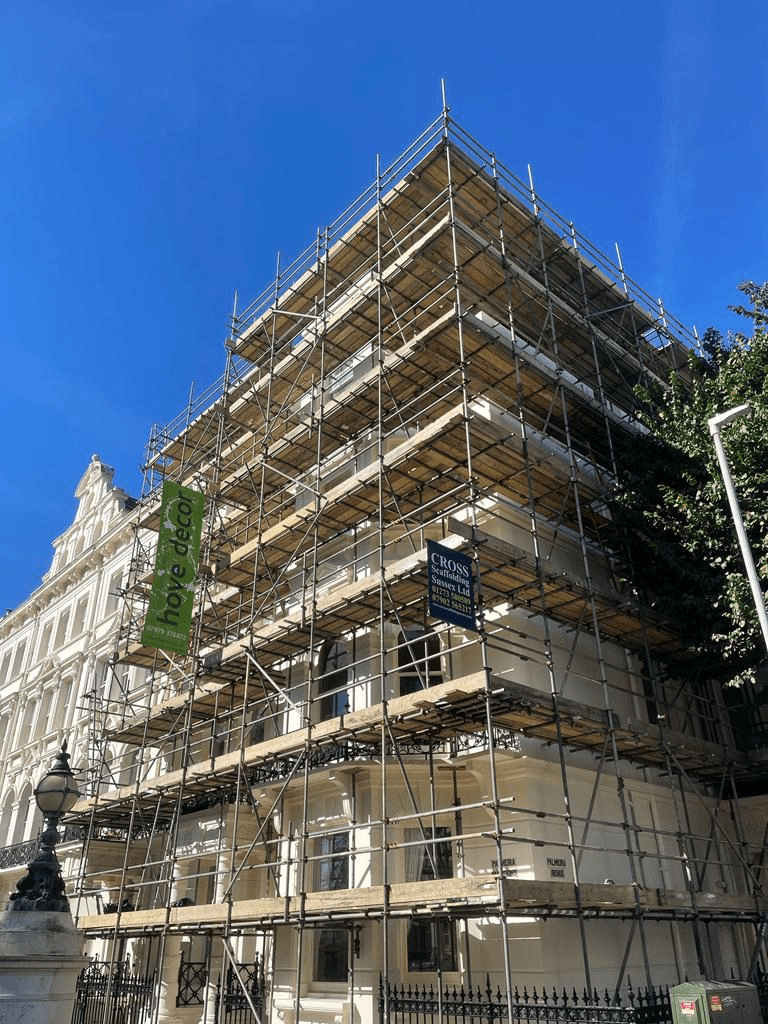
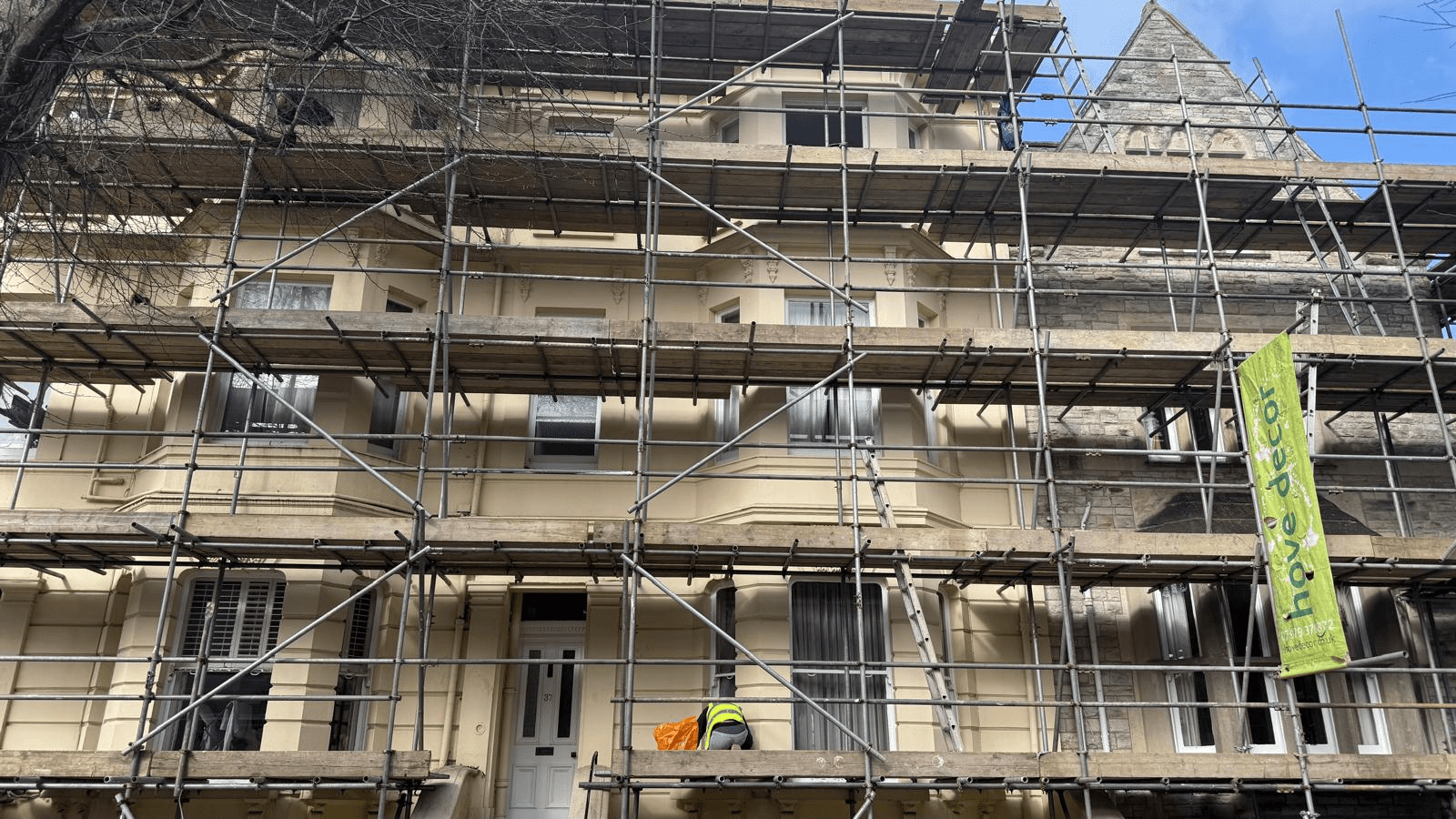
On most Brighton terraces the upper elevations can only be done properly off scaffold, not ladders. Safe, steady access lets you prep the whole wall thoroughly, and on the coast that preparation is what makes the difference between a repaint that lasts years and one that flakes again in a season.
A lot of the exterior work around here is on terraces, where the wall runs up two or three storeys and shares edges with the neighbours. To do the job properly you need scaffold, not someone stretching off a ladder. Scaffold means I can wash down, treat, stabilise, fill and paint the whole elevation at a steady, consistent standard, and reach the awkward sections around the cills and the top of the wall where the flaking usually starts.
It also means the prep gets the time it needs. By the coast the finish is the easy part. It is the washing, the treating, the stabilising and the filling that decide whether the repaint holds, because all the forces that lifted the last coat, the salt, the driving rain and the trapped damp, are still there. Rush the prep and you are just painting over the same problem in a nicer colour.
I have been repairing and repainting exteriors across Brighton and Hove for around 20 years, and I am fully insured. If you have a sea-facing wall that keeps flaking, or render that looks tired before its time, ask for an estimate with a few photos and I will come and take a look.
Frequently asked questions
Why does my exterior paint keep flaking?
Usually because moisture is trapped in the wall. If the surface was coated with a cheap, non-breathable masonry paint, water still gets into the wall through cracks and cill lines but cannot dry back out, so it pushes the paint off from behind. By the coast, salt air and driving rain make this far worse. The fix is to treat and stabilise the surface, sort out where the water is getting in, and repaint with a breathable masonry paint so the wall can release moisture.
What is the best masonry paint for a coastal house?
A breathable one that stands up to weather. On most rendered and modern walls a quality flexible masonry paint like Dulux Weathershield Smooth or a Bedec masonry paint works well. On older solid or lime-render period properties, a mineral paint such as Beeck or Keim is better because it lets the wall breathe. The key on the coast is breathability plus proper preparation, not just the brand on the tin.
Do I need breathable masonry paint?
On older solid walls and lime render, yes. Those walls were built to let moisture pass through and dry out, and sealing them with a non-breathable paint traps damp inside, which lifts the paint and can push damp indoors. A breathable masonry paint lets the wall release moisture. On newer cavity-wall render it matters a little less, but breathability rarely hurts and by the coast it usually helps.
Can you just paint over flaking masonry paint?
No. Painting over flaking, chalky or algae-covered render just seals the problem in and the new coat lifts off with the old one. The surface has to be washed down with a fungicidal wash, scraped back to what is sound, then stabilised with a binding primer like Zinsser Peel Stop before any topcoat. That preparation is what makes the repaint last, especially on an exposed coastal wall.
More reading
Related service
Want this doing in your own place? See my exterior painting service across Brighton & Hove.